

Clear Air, Clear Water, Healthier Yacht Crew
Life onboard a superyacht takes place within a carefully engineered environment.
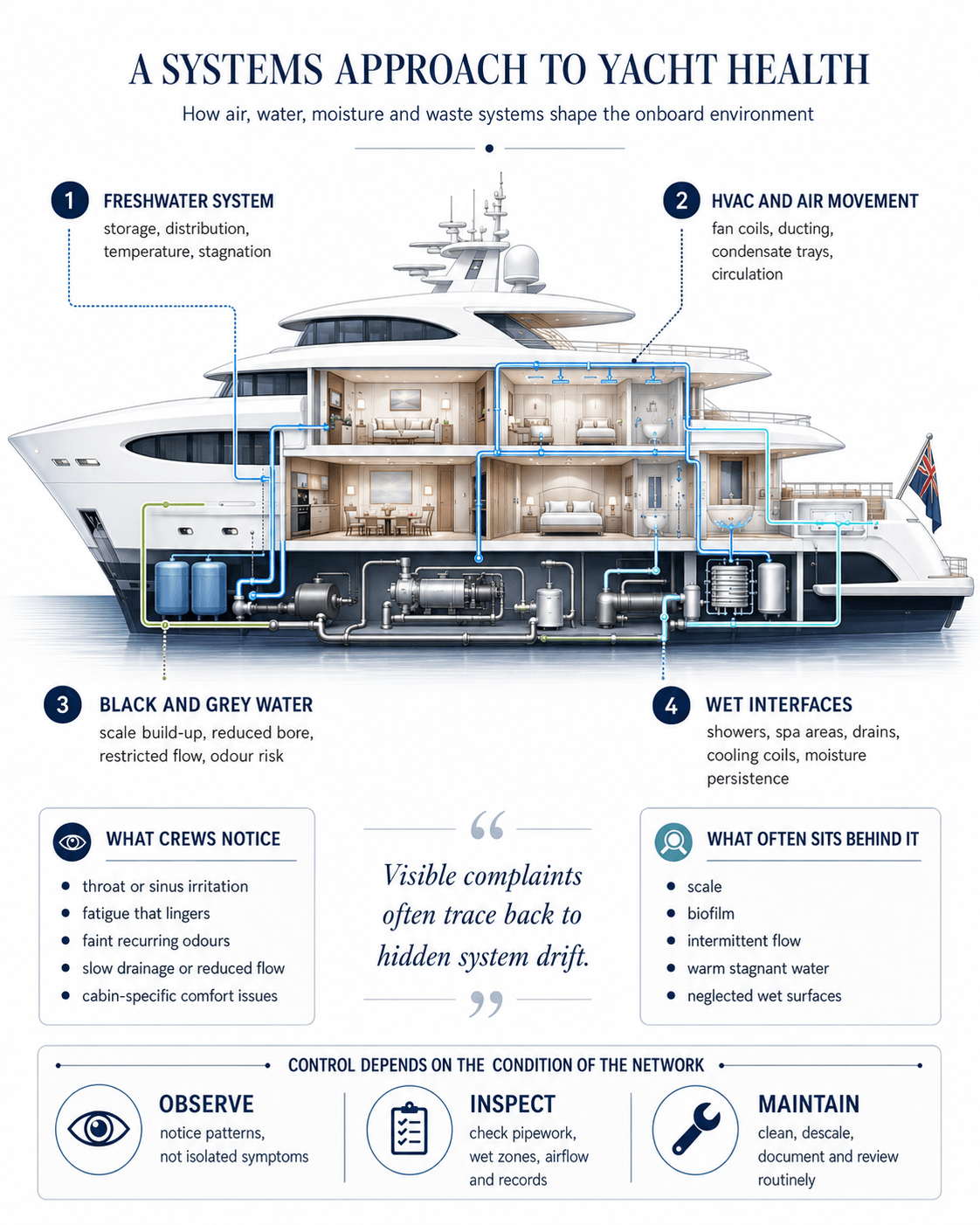
Air circulates quietly through concealed ducts. Water is stored, heated, and cooled as required. Pipes may stay warm for extended periods, with demand rising quickly during owner use, charters, guest activity, or seasonal changes.
When these systems function properly, they remain unnoticed. This reliability is achieved through consistent performance.
When environmental controls decline, signs are rarely obvious technical failures. Instead, they may include recurring throat irritation, persistent fatigue, faint untraceable odours, slow drainage, cabin-specific comfort complaints, or repeated minor issues.
It is important to remember that compliance and control are not the same.
A yacht may produce a clean tap sample while upstream pipes remain scaled. A cabin may smell fine even if a fan coil or a condensate tray is contaminated. A vessel can seem balanced during a busy season, then decline during a warm lay-up or low-use period.
For yachts using Singapore as a regional cruising, service, event, or transit hub, these hidden systems deserve particular attention. Warm conditions, high humidity, marina stays, yard periods, and changing usage patterns can all influence how onboard air, water, and waste systems behave between service intervals.
Onboard hygiene should be viewed as system behaviour rather than a checklist of isolated tasks.
Water risk extends beyond the outlet
Potable water remains one of the highest-risk pathways onboard, particularly where temperature, stagnation and system condition create the right environment for bacterial growth.
Legionella attracts attention because the mechanism is well understood. It can proliferate where water temperatures favour growth and flow is intermittent. Exposure usually occurs through inhalation of aerosolised water from showers, spa pools, water features or other outlets that create fine spray.
For yachts, the concern is not only the organism but also the underlying system behaviour.
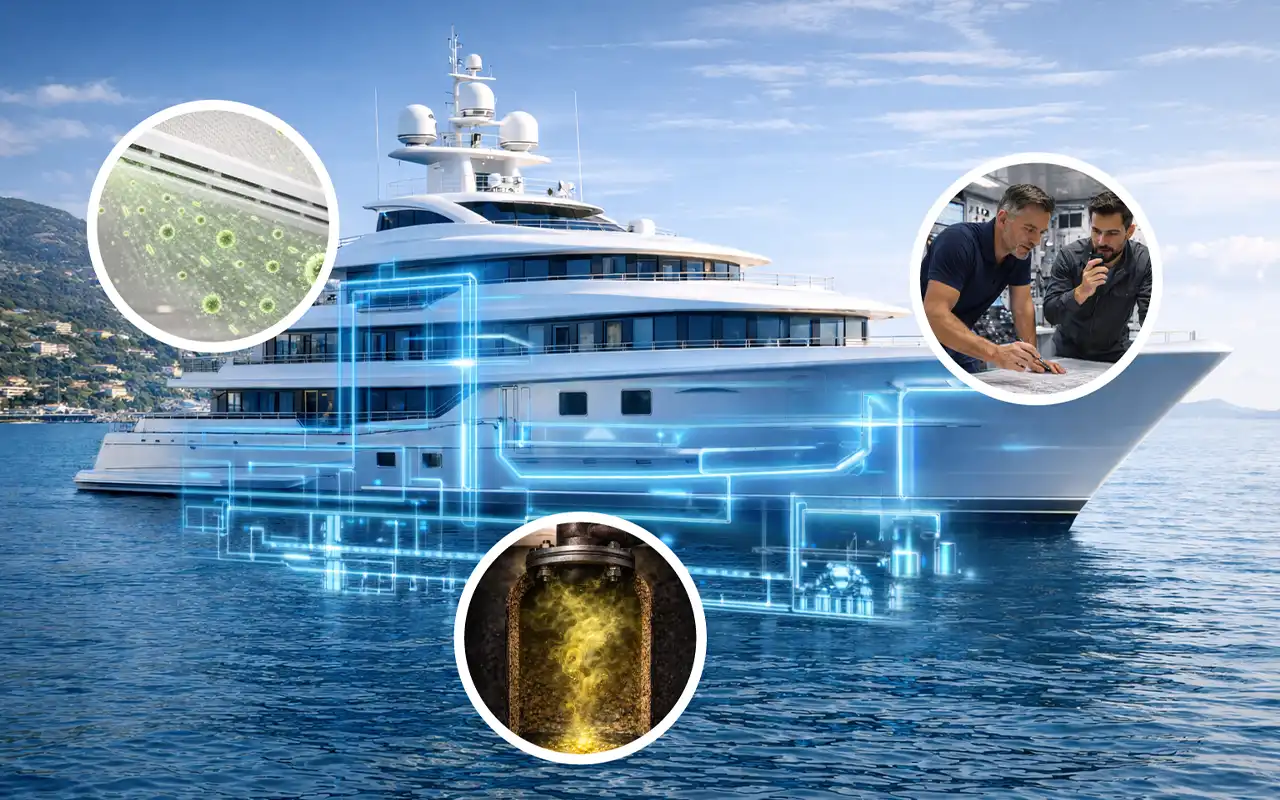
Water may look clean at the outlet, while less visible parts of the network hold scale, biofilm or stagnant branches. Once biofilm has established, microorganisms may become more difficult to reach through normal treatment. Mineral scale can compound the issue by creating rough surfaces where deposits and biological material can persist.
Routine flushing, temperature control, shower-head cleaning, representative monitoring, and post-lay-up checks are essential. These actions are not mere formalities. They disrupt conditions that allow water risks to develop.
HVAC systems impact more than air quality
Air systems are often evaluated based on comfort: Is the cabin cool enough? Is the airflow balanced? Is there an odour?
However, HVAC systems also influence the onboard microclimate. Fan coils, condensate trays, ducts, drains, and air-handling units can accumulate dust, moisture, and biological debris over time. Once contamination occurs, airflow can distribute it throughout accommodation spaces.
Symptoms often present as inconveniences rather than illness, such as sinus or throat irritation, mild headaches, fatigue, allergic reactions, or discomfort associated with specific spaces.
Charters change, crew rotate, and seasons shift. As a result, symptoms are often attributed to other causes.
Air systems rarely create risks independently. They distribute existing contaminants.
The practical response is removal and stabilisation. This involves thorough cleaning of air-handling units and fan coils, managing condensate trays and drains as active wet zones, removing accumulated debris, and applying targeted disinfection where surface conditions have allowed growth.
For local operators, owners, and managers, Singapore marine maintenance services should be considered part of wider onboard environmental control, particularly where air hygiene, odour control, and wastewater performance affect guest and crew comfort.
Waste systems contribute to the onboard environment
Black and grey water systems are physically separate from potable water but remain relevant to the overall onboard environment.
Over time, mineral scale and organic build-up narrow pipe diameters, slowing flow and reducing clearance reliability. Sediment settles, odour issues become harder to trace, and gas migration, leakage, or maintenance cross-connections can allow downstream conditions to affect occupied spaces.
Descaling is a structural intervention, not routine housekeeping.
Removing accumulated mineral and organic build-up restores flow and eliminates persistent reservoirs that contribute to recurring odour, poor drainage, and ongoing maintenance issues.
Localised dosing can help stabilise cleaner systems, but its effectiveness is limited. Where restrictions have already developed downstream, yacht wastewater pipe descaling may be required to restore flow and remove persistent deposits within the network.
Sophisticated yachts are more sensitive, not less
Superyachts are designed for discretion, comfort, and quiet operation. Systems are concealed, access is limited, pipe runs are long, air-handling components are located in tight spaces, and wet zones are distributed across accommodation, service, and guest areas.
These design priorities, while enhancing the onboard experience, can also make system drift harder to detect.
As yachts grow in size, complexity increases. Additional cabins require more branch lines, and expanded amenities increase storage volume, heating and cooling cycles, wet interfaces, and condensate production. Minor changes can go unnoticed before surfacing as complaints.
A cultural factor also exists. Health issues onboard are not always discussed openly. Symptoms may be managed quietly, attributed to travel or fatigue, or simply endured. Crew turnover can obscure recurring patterns throughout a season.
Silence does not always indicate absence.
To address this, yachts need straightforward ways to record minor observations before they become patterns. A recurring odour, cabin-specific irritation, slow drain, fan coil issue, or change in water temperature may seem minor individually, but together they can indicate system drift.
Engineers, interior teams, officers, and managers should be able to share observations without blame and compare them with flushing records, HVAC inspections, water temperatures, odour reports, and recent maintenance work.
Control is not a single event. It is a maintained condition.
The goal is not to increase paperwork, but to provide crews with a way to detect system drift early, before guests or crew experience the consequences.
About Clearvac Engineering Asia
Clearvac Engineering Asia works with superyachts, cruise ships and commercial vessels across Southeast Asia and beyond.
Services include HVAC hygiene, freshwater system descaling, black- and grey-water pipe descaling, and fire-risk removal from galley and laundry extraction systems. For vessels where extraction systems are part of the hidden risk picture, galley and laundry extraction cleaning can support hygiene, documentation, and fire-risk control.
The company focuses on the hidden infrastructure that underpins onboard comfort, hygiene, and operational reliability, with practical interventions supported by photographic reporting and technical documentation.
This article is adapted from a longer technical piece by Clearvac Engineering Asia. Read the full article on superyacht air and water hygiene here.